

A game-changer for predictable and cost-effective file sharing.
You may have thought about moving your unstructured file share storage from an on-premises solution, from servers on VMware or Hyper-V, possibly even from AWS storage, to Azure file shares. If you're not familiar with what you can do with Azure file shares, take a look at Microsoft's Azure Files overview.
In the past, estimating the expense of Azure File Shares has been quite complicated, to say the least. The issue stems from the way that Microsoft calculate cost, using varying and hard to predict factors that aren't necessarily visible until you're using the platform. This includes the amount of data stored, the frequency of access, and the types of transactions involved. This complexity can make budgeting for storage unpredictable, leaving you uncertain about expenditures and sometimes being a roadblock for moving to cloud storage.
While storage tiers helped us to adjust storage configuration to reduce costs once data was in Azure file shares, the additional complexity of moving between tiers introduced additional cost.
Enter Azure Files Provisioned V2! (yes, marketing were involved in that name 😉).

Azure Files Provisioned V2 aims to address these challenges by simplifying the cost structure. With this new model, Microsoft has introduced a more straightforward and predictable approach to calculating storage costs. By offering a provisioned capacity model, organisations can now pay a fixed rate based on the amount of storage they provision, regardless of the number of transactions or the frequency of access.
Why is this important?
Azure Files Provisioned V2 is a significant improvement for several reasons. Firstly, it offers cost simplification and is crucial for businesses of all sizes. By eliminating the need to track and calculate transaction-based costs, organisations can more accurately plan for anticipated storage costs, before moving data to Azure.
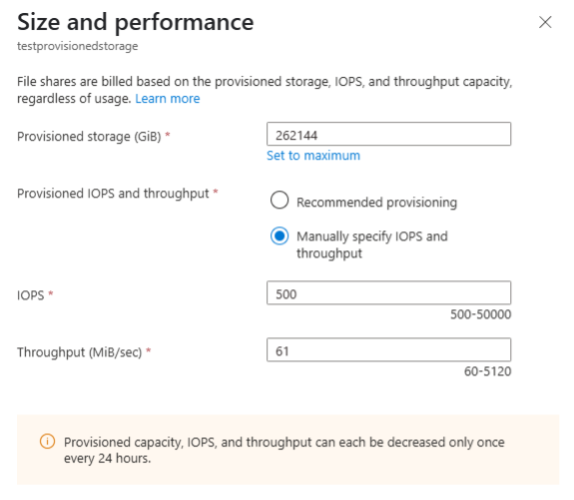
With Azure Files Provisioned V2 you set three more familiar values, that may seem similar to on-premises storage, so will make choosing your configuration easier.
- How much data you need to allocate. Think of this as a traditional file server volume, except when you run out of space on Azure files, you simply extend the volume.
- The networking throughput. How big does our networking connection to Azure files need to be? Again, this is adjustable.
- IOPS, which refers to Input/Output per second. IOPS will help with how quickly the storage responds to requests, and is of course adjustable.
With those three values, you can tune the storage profile to the needs of the type of data you are storing, from uses such as archive data through to highly transactional workloads. If you're concerned about limitations, right now in Australia you can scale to a maximum of 262,144 GB of storage, 50,000 IOPS and 5 GiB per second, which is about 43 Gbps for those more technical among you.
Our conclusion? Azure Files Provisioned V2 represents a significant leap forward in the realm of cloud storage. By simplifying the cost structure and offering predictable pricing, it empowers organisations to manage their budgets more effectively. Whether you are a small business or a large enterprise, this new model can help you achieve greater financial stability and operational efficiency.
If you're interested in moving your existing storage, or are already using Azure Files but want to move to a more predictable solution, we'd like to talk to you.